
Blog · SEO without the hype
How to forecast SEO traffic before you commit the budget
Every SEO proposal contains a number nobody can defend. The client asks what they will get, the agency says "significant growth," and both sides sign something neither of them can measure against.
There is a better answer. Not a precise one, because precision is not available here, but a defensible range built from what comparable sites actually achieved. The method takes about a day and produces three scenarios you can put in front of a finance director.
Start with the caveat, because it matters more than the method: any forecast made before work begins is approximate. Accuracy improves after a detailed competitor link analysis, and improves again with each project you run and check afterwards. Anyone presenting a single confident number has either done no analysis or is telling you what you want to hear.
Two ways to forecast, and why competitors beat keywords
You can forecast from your own keyword list, multiplying search volumes by expected click-through rates at expected positions. It sounds rigorous. It compounds three estimates, each of which can be wrong by a factor of two.
Forecasting from competitors works differently. You find sites that already did what you are proposing to do, measure what it took them, and scale to your situation.
It also answers three questions the keyword method cannot: how competitive the niche actually is, roughly how many referring domains you will need, and what the acquisition budget looks like.
The method
1. Collect enough semantics to find competitors. Two to three hundred keywords is sufficient at this stage. You are not building a content plan yet, you are identifying who owns the space.
Take a few head terms, pull the top ten for your target country, and clean the list. Remove aggregators, marketplaces, social platforms, and anyone whose service scope is far broader than yours. A comparison site ranking for your term is not your competitor in any useful sense.
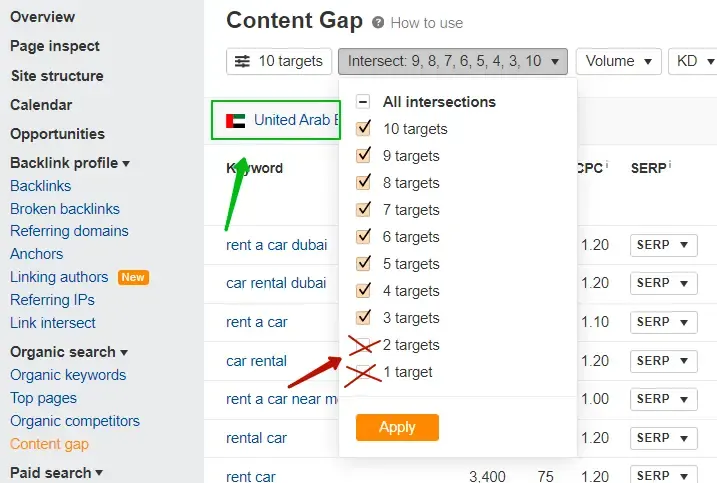
Then run a content gap analysis across the surviving sites to expand the keyword set. Exclude keywords where only one or two of them intersect, because those are usually noise rather than shared demand.
2. Identify the actual leaders. Take the expanded semantics and pull the top ten for each. The sites that appear repeatedly are your reference set. This is different from the sites that rank for your head term, and usually more useful.
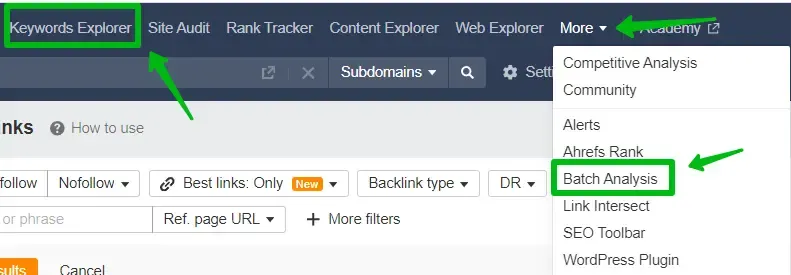
3. Assess the competition level. Run a batch analysis on the reference set and look at domain-level authority. Then check keyword difficulty for the head query of each cluster.
In the worked example this method was built on, a car rental market, the head term scored 70 for difficulty and the cluster heads averaged around 40. Reference domains sat above 45 authority. That combination reads as medium competition or higher, which sets expectations for everything downstream.
One useful piece of paranoia: if the numbers look easier than the market feels, assume some participants are using acquisition methods that do not show up in public link indexes.
4. Choose the right competitors for the forecast. This is the step most people get wrong.
You are not comparing yourself to the market leader. You are comparing yourself to sites that started where you are starting. Find sites that grew from nothing in the last two to three years. If there are none, widen to three or four years. Sites that took five or six years are still informative for analysis but poor forecasting references, because the search landscape they grew into no longer exists.
In the original example this filter left exactly one site at the two to three year mark, which forced widening the window. That is a normal outcome and worth knowing in advance.
5. Filter the links down to the ones that count. Raw referring domain counts are useless because most of any profile is noise. You want links that plausibly transmit something.
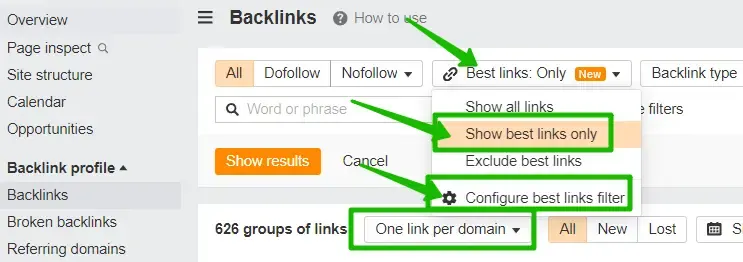
Reasonable filter settings: minimum domain authority above zero, referring page traffic above 100, subdomains excluded, outbound link count on the referring page capped, one link per domain, best link per domain only.
The exact thresholds matter less than applying the same ones consistently across every competitor. You are building a comparison, not an absolute measure.
6. Derive traffic per link. For each reference site you now have filtered link count and organic traffic. Take medians rather than means, because one outlier will distort a small sample.
That gives you a rough traffic yield per quality referring domain in this niche. It is crude. It is also the only empirically grounded number in the whole exercise.
Then adjust for reality:
Suppress the first three months. Implementation lags, developer queues, and link acquisition all take longer to start than anyone plans for.
Apply a compounding factor, because link effects accumulate rather than arriving linearly. A domain acquired in month two is contributing more in month ten than a domain acquired in month nine.
7. Build three scenarios, not one.
| Scenario | Assumption | Typical outcome |
|---|---|---|
| Optimistic | More referring domains than competitors have, and better quality | Faster growth, requires roughly 1.5x the calculated link volume |
| Realistic | Comparable link volume and comparable quality | Growth tracking competitor trajectories |
| Pessimistic | About half the link volume, comparable quality | Slower, still positive, useful as a floor |
The pessimistic scenario is the one that earns trust. A proposal containing a floor is a proposal from someone who has been wrong before and learned from it.
Turning the forecast into a budget
Once you know how many referring domains you need, cost becomes arithmetic. What it does not tell you is what those domains should cost, and that is where forecasting methodology and ethics collide.
The original version of this method assumes a third to two thirds of the link profile comes from paid guest placements at roughly €140 each, and suggests acquiring expired domains with existing link history for the aggressive scenario.
We do not work that way, and it is worth explaining why rather than just asserting it.
Google's link spam policies explicitly cover buying links for ranking purposes and large-scale guest posting with keyword-rich anchors. The risk is not that a placement gets discounted, which is the common outcome and merely wasteful. The risk is a pattern becoming visible across a profile. For a B2B company whose domain carries the brand, that is not a ranking problem, it is a business one.
Expired domain acquisition is a clearer case. The entire value proposition is inheriting authority you did not earn, which is the definition of the thing the policy addresses.
The forecasting maths does not change. You still need a certain number of quality referring domains, and the traffic-per-link figure is derived the same way. What changes is the cost and time structure:
Digital PR and industry publications. Slower, more expensive per placement, durable. In European B2B the relevant trade press is small enough to approach individually.
Partner and integration directories. Cheap, legitimate, and consistently underused. Every software vendor, supplier, and certification body you work with has a listing you are not in.
Customer case studies published on the customer's site. The best link type in B2B and usually free. It requires a relationship rather than a budget.
Conference and association pages. Speaker listings, member directories, event sponsorship. Priced as marketing, delivers links as a side effect.
Original data. Surveys, benchmarks, industry reports. The highest cost per attempt and the highest ceiling.
The honest comparison: legitimate acquisition typically costs more per referring domain and takes longer to reach the same count. Set the forecast timeline accordingly rather than pretending the two paths run at the same speed. A twelve-month realistic scenario built on earned links is a different document from a twelve-month scenario built on purchased ones, and the difference should be visible in the timeline, not hidden in the assumptions.
Constraints worth writing into the plan
From repeated application of this method:
Critical technical work must land in the first two months. A forecast assuming otherwise is forecasting a different project.
Content production starts by month two at the latest.
Link acquisition starts by month two or three. Starting later pushes the compounding curve past the horizon you are forecasting against.
Growing roughly twice as fast as competitors is achievable, but requires something like 1.5 times the calculated link volume or materially better link quality.
Growing well on 30 to 40% fewer links is also achievable, if you concentrate on local and regionally relevant sites and on placements that sit on strong pages rather than buried in archives.
What the number actually means
Two adjustments before anyone treats the output as a target.
Forecast traffic is modelled on what third-party tools report, and those tools systematically understate real traffic. Depending on market, actual figures often run one and a half to two times higher. Useful as upside, not as a promise.
And traffic is not the deliverable. For B2B, the chain runs traffic to enquiries to qualified opportunities to closed revenue, and the conversion rates in that chain vary more between companies than traffic forecasts vary between scenarios. A forecast that stops at sessions has answered a question nobody asked.
The genuinely useful output is not a number. It is a defensible range, an explicit list of what has to be true for it to hold, and a floor you are willing to be measured against.
---
Frequently asked questions
Can SEO traffic actually be forecast?
Approximately. A competitor-based model produces a defensible range. Anyone offering a precise figure before analysis is guessing.
How accurate are these forecasts?
Accurate enough to make a budget decision, not accurate enough to write into a contract as a guarantee. Accuracy improves after detailed competitor link analysis and improves with practice.
Why forecast from competitors rather than keyword volumes?
Keyword-based forecasting multiplies several estimates together and compounds the error. Competitor-based forecasting measures what comparable sites actually achieved.
Which competitors should I use as references?
Sites that grew from zero within the last two to three years in your market. Established leaders are poor references because they grew under different conditions.
How long before SEO produces measurable traffic?
In competitive European B2B, first meaningful organic traffic typically appears in months three to six, with compounding over the following year. The first three months are mostly implementation.
Do I need to buy links to hit the forecast?
No, but the timeline changes. Earned links cost more per domain and arrive more slowly. That belongs in the forecast rather than hidden in the assumptions.
What if my niche has no recently grown competitors?
Widen the window to four or five years and treat the forecast as less reliable. It can also be a signal that the market is closed, which is itself worth knowing before committing budget.
See also
Get a free express audit of your website
We'll check indexing, speed, content and the backlink profile, name the three biggest problems and the order of work. Real findings, no filler, no strings attached — the report is yours to keep either way.