
Blog · SEO without the hype
Ranking third in Google guarantees nothing about where you sit in Bing. Not top ten. Sometimes not top hundred. Most people discover this by accident, usually while investigating why a client in Germany reports finding a competitor they have never heard of.
Microsoft's search index does not only serve Bing. It also underpins Copilot, and it has been the retrieval layer behind ChatGPT's web search. Yahoo runs on it. DuckDuckGo draws from it for web results.
So when a buyer asks an assistant to recommend suppliers in your category, the shortlist is frequently assembled from an index you have never checked your position in.
That is a different proposition from "capture an extra few percent of search traffic." It is the difference between being considered and not existing, in a channel where the buyer never sees a results page and never scrolls past you. They receive three names.
Reported market share for Bing varies considerably depending on who measures and whether mobile is included, and the numbers move. The strategic case does not rest on the share figure. It rests on which systems query the index.
The two engines agree on most fundamentals and diverge on specifics that matter.
Crawl speed. Bing's crawler is slower and less persistent than Google's. Deep pages, weakly linked pages, and large sites suffer disproportionately. The practical response is a flatter architecture, ideally no more than three levels from the homepage, with genuine internal linking rather than a reliance on sitemaps to do the work.
IndexNow. This is the concrete advantage and it is underused. Bing supports a push protocol: when you publish or update a page, you notify the index directly instead of waiting to be crawled. It is a small implementation, it is free, and on a site that publishes regularly it is the single highest-return item on this list.
Structured data. Bing's own guidance favours Schema.org in JSON-LD. Because the crawler is slower and the index thinner, explicit markup does more work here than it does in Google. Where Google can often infer structure, Bing is more likely to take what you declare.
Literal matching. Bing is measurably more responsive to exact phrase presence in the title, H1, and body than Google is. Google resolves synonyms and intent more aggressively. This does not mean stuffing keywords. It means that if a page is about a specific term, the page should contain that term in its heading rather than only a paraphrase of it.
Click behaviour. Bing appears to weight engagement signals more directly, which puts a higher premium on a snippet that gets clicked. Structured data improves snippet appearance, which is a second reason it matters more here.
Freshness. Both engines favour updated content. Bing's slower crawl makes the effect lumpier, which is another argument for IndexNow.
Setting it up takes about ten minutes and it imports your Search Console configuration directly, so there is almost no work involved.
What you get is a second, independent view of your own site. Different crawl statistics, different index coverage, a different keyword list. When Google Search Console and Bing Webmaster Tools disagree about whether a page is indexed, that disagreement is diagnostic information you cannot get any other way.
For a multilingual site it is particularly useful, because hreflang problems often surface in one index before the other.
Most European B2B sites are optimised for a single engine and a single language, then extended with translations. That works until it meets three separate realities.
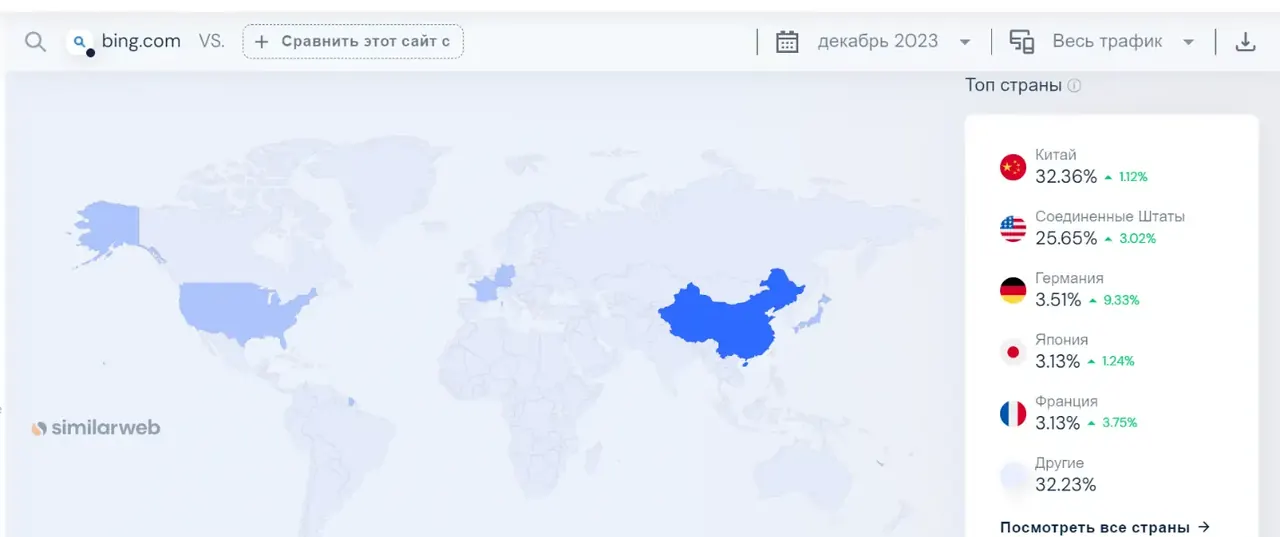
Different countries have different engine mixes. Bing's share is not uniform across Europe, and desktop-heavy B2B audiences skew toward it more than consumer averages suggest.
Different countries have different query languages for the same intent. A German buyer searching for SEO Audit Kosten and a British buyer searching for seo audit cost are the same person commercially and two different keyword sets operationally.
And AI-assisted research is arriving unevenly. A market where buyers already ask an assistant to shortlist vendors behaves differently from one where they still open ten tabs.
The practical sequence we use: get one market working properly in Google, verify the same pages in Bing Webmaster Tools, fix whatever the second index disagrees about, then replicate. Attempting all markets and both engines simultaneously produces a site where nothing is checked properly.

The older generation of Bing advice includes several things that were either always bad or have aged into liability. They still circulate, so they are worth naming.
Keyword-matching domain names. Bing has historically shown more tolerance for exact-match domains than Google. Building a B2B brand around a keyword string in order to exploit that is trading a durable asset for a temporary ranking effect. It also looks exactly like what it is to a buyer evaluating suppliers.
Exact-match anchor text at scale. This surfaces in a lot of Bing guidance, and it is one of the clearest patterns search engines use to identify manipulated link profiles. Whatever short-term effect exists is not worth carrying that shape in your profile.
Directory submissions and guest post campaigns for links. Bing's own guidelines explicitly penalise sudden link growth. The advice to build links "by adding the project to directories and publishing guest posts" describes a pattern both engines are looking for.
Social signals as a ranking lever. Follower counts and engagement metrics are frequently listed as Bing ranking factors. Treat social as a distribution channel that gets content discovered and linked. Buying engagement to influence rankings is the same category of mistake as buying links, with worse economics.
Bing is explicit that it demotes machine-generated filler, abrupt link acquisition, automated social activity, and duplicate content. The list of things it punishes is more useful than most of the advice about what it rewards.
None of this is a separate SEO programme. It is a checklist you run once and revisit quarterly, and most of it improves your Google position as a side effect.
---
For B2B in Europe and the US, yes, mainly because Microsoft's index feeds Copilot and has served ChatGPT's web search. Being absent from that index means being absent from assistant-generated shortlists.
Not reliably. The engines diverge on crawl behaviour, literal matching, and structured data weighting. Positions can differ substantially.
A protocol for notifying search engines directly when content changes, supported by Bing. It removes the wait for a crawler to rediscover a page, which matters more on Bing than Google because Bing crawls less frequently.
Yes, and index coverage varies by market. Verify each language version separately rather than assuming behaviour carries across.
Older guidance says yes. Treat social as distribution rather than as a ranking input, and do not buy engagement.
Slower than Google. Allow around six weeks before drawing conclusions, or use IndexNow to compress that.
We'll check indexing, speed, content and the backlink profile, name the three biggest problems and the order of work. Real findings, no filler, no strings attached — the report is yours to keep either way.