
Blog · SEO without the hype
Your Search Console report is not measuring what you think it is
If you receive a monthly SEO report, most of it is built on Google Search Console. It is the only source of query-level data anyone has, which makes it indispensable and also means its distortions get inherited by every report downstream without comment.
None of what follows is a reason to stop using it. It is a list of the places where the number does not mean what the row label says.
Traffic that is not search traffic
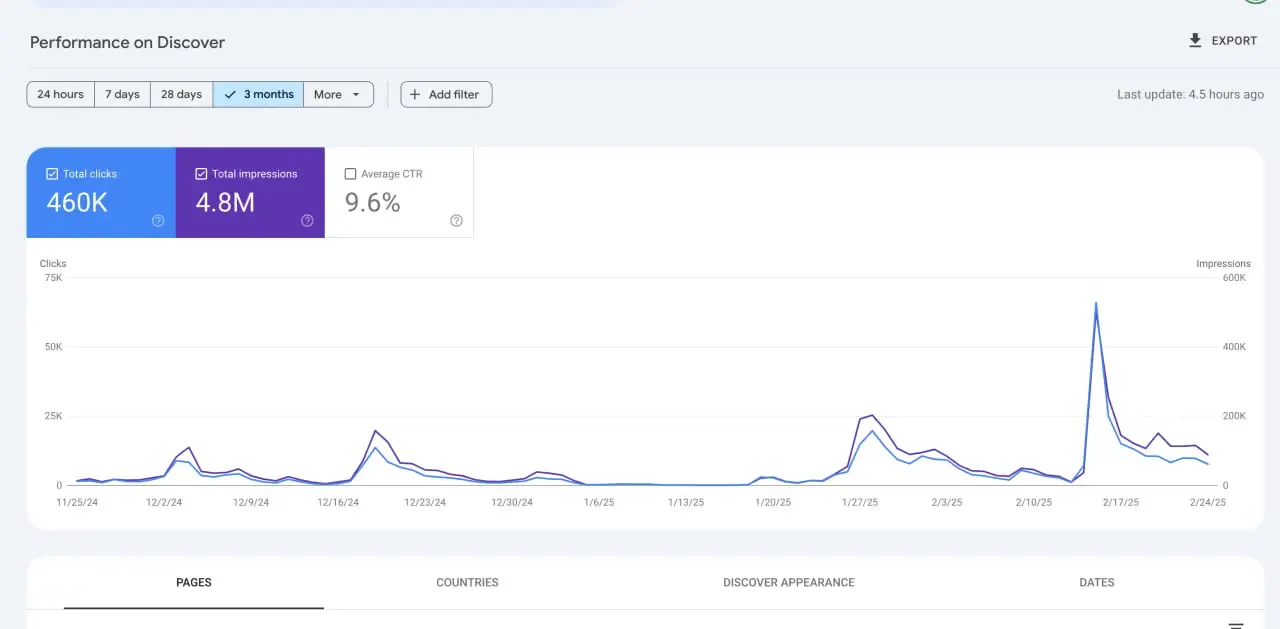
Google Discover is the recommendation feed in the Google app. It is not search. Nobody typed anything.
Discover has its own report in Search Console, which is the tidy version of the story. The untidy version is that Discover traffic frequently lands in analytics attributed as organic search, because the referrer looks the same. Teams that have never separated it are reporting recommendation traffic as SEO performance.
There is a second, more recent variant that is harder to spot. The Google mobile app sends push notifications with headlines that read like Discover recommendations. Tapping one does not open the article. It opens a search results page for a query Google inferred from the topic, with your page in it.
From Search Console's perspective that is an impression and a click in the Search results report. It is indistinguishable from someone typing the query. From your perspective it is a recommendation Google decided to send, which can stop at any time for reasons you will never see.
The tell is a cluster of single-word or very short topical queries with click-through rates far above anything plausible for their position. A commercial term at position six does not convert at 70%. When you see that pattern, you are looking at traffic that was delivered rather than earned.
What to do about it is a judgement call. It is real traffic and real readers. Counting it as evidence that your SEO strategy is working, and forecasting from it, is where the mistake happens.
Average position is an average of the wrong thing
The number labelled "average position" is the mean of your best position for each query across all impressions. It mixes head terms and long tail, desktop and mobile, every country, and every SERP feature layout.
A site can improve its position for every single query and watch average position get worse, because newly ranking long-tail terms enter at position 60 and drag the mean. This happens constantly on sites that have just published a lot of content, which means it happens exactly when the report needs to show progress.
Average position is useful for one thing: comparing a single query against itself over time. As a site-level health metric it is close to meaningless, and it appears at the top of most reports.
Most of your queries are hidden
Search Console withholds queries that are too rare, to protect user privacy. The threshold is not published and it moves.
The consequence is that the sum of clicks across the query rows will not match the total clicks for the same period. The gap is often large. On a site with a long tail, half the clicks can sit behind queries you are not permitted to see.
This matters when someone concludes that a page "only ranks for three keywords." It ranks for three keywords you were shown.
The property type changes the answer
A domain property covers every subdomain and both protocols. A URL-prefix property covers exactly what its prefix says.
Reports built on a URL-prefix property for https://example.com/ do not include www.example.com, and will silently under-report if any traffic goes there. This is a common finding on sites where the canonical host was never enforced, and it is one reason two agencies can produce different numbers for the same month.

Filters that quietly change the meaning
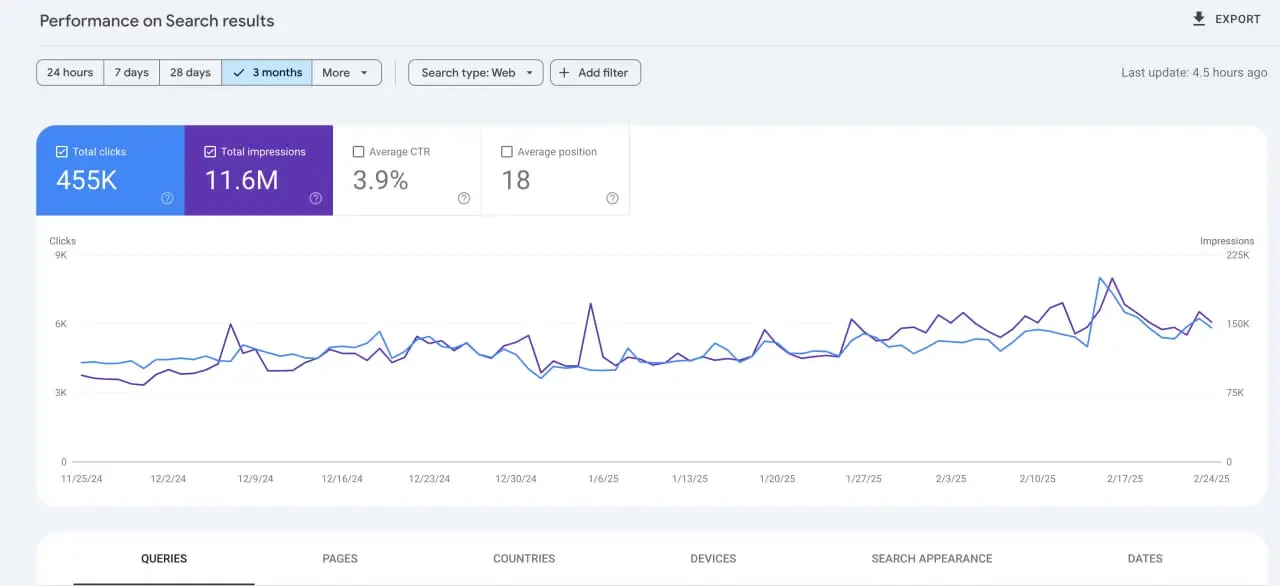
The default Search Console view is "Web" search type. Image, video, and news are separate. A site that gets meaningful image traffic will look smaller than it is.
Country filtering matters more than most reports acknowledge. For a multilingual site, aggregate numbers blend markets with completely different competitive positions. A German page at position 8 and a Turkish page at position 90 average into something that describes neither.
Lag, and different lag per report
Performance data appears within a day or two. Indexing reports lag by considerably more, sometimes weeks.
This produces a specific misunderstanding: you submit a sitemap, check the Pages report a few days later, see no change, and conclude the submission did nothing. The submission is a discovery hint, not an instruction to crawl. For a new site with few external links, several weeks before the indexing reports move is normal rather than a problem.
Why Search Console and analytics never agree
They count different events. Search Console counts a click on a search result. Analytics counts a session that loaded tracking code.
Between the two you lose people who bounce before the script fires, anyone blocking analytics, anyone who declined cookie consent, and anyone on a slow connection who left early. You gain, in analytics, sessions that arrived from Discover, from the push notifications above, or from a referrer that resolved to organic.
A discrepancy of ten to twenty percent between the two is normal. A discrepancy of eighty percent is a configuration problem worth investigating. Neither tool is more correct than the other, because they are answering different questions.
What a report should actually contain
If you are receiving one, ask for these instead of the standard summary:
Clicks and impressions by market, separately. Not aggregated, if the site serves more than one country.
Position for a fixed set of named priority queries, tracked over time. Not average position across everything.
Discover excluded, or reported separately and labelled.
The indexed-page count from the Pages report, with movement explained. This is the most under-reported number in SEO and often the most diagnostic.
Queries where impressions are growing but clicks are not. This is where the money usually is. It means you are visible and the snippet is not persuading anyone, which is a title and description problem you can fix in an afternoon.
An honest note about what the data cannot show. Anonymised queries, Discover contamination, and lag are all real. A report that presents Search Console output as complete truth was assembled by someone who has not looked closely, or by someone hoping you will not.
The practical takeaway
Search Console is the best data available and it is not a ledger. Treat it as a directional instrument with known distortions, the way you would treat any measurement tool with a documented margin of error.
The failure mode we see most often is not a wrong number. It is a decision made on a number that was never measuring the thing the decision was about. Traffic from a recommendation feed becomes evidence that a content strategy is working. An average position dragged down by newly ranking pages becomes evidence that something broke. Neither conclusion survives ten minutes of looking at the underlying rows.
---
Frequently asked questions
Is Google Search Console data accurate?
It is accurate about what it measures and frequently misread. Query-level data is incomplete by design, average position is a blend, and some traffic reported as search did not originate from a search.
Why don't Search Console and Google Analytics match?
They count different events. Search Console counts result clicks, analytics counts tracked sessions. Ten to twenty percent variance is normal.
Why is my average position getting worse while rankings improve?
Newly ranking long-tail queries enter at low positions and pull the average down. Publishing a lot of content reliably produces this effect.
Why don't my query clicks add up to my total clicks?
Search Console hides queries below a volume threshold for privacy. The hidden portion can be substantial.
Does Discover traffic show up as organic search?
It has its own report, but it is often attributed as organic in analytics, and notification-driven visits can register as search impressions and clicks.
I submitted a sitemap and nothing changed. Why?
Indexing reports lag by weeks, and a sitemap is a discovery hint rather than a crawl instruction. On a new site with few links, several weeks is normal.
See also
Get a free express audit of your website
We'll check indexing, speed, content and the backlink profile, name the three biggest problems and the order of work. Real findings, no filler, no strings attached — the report is yours to keep either way.